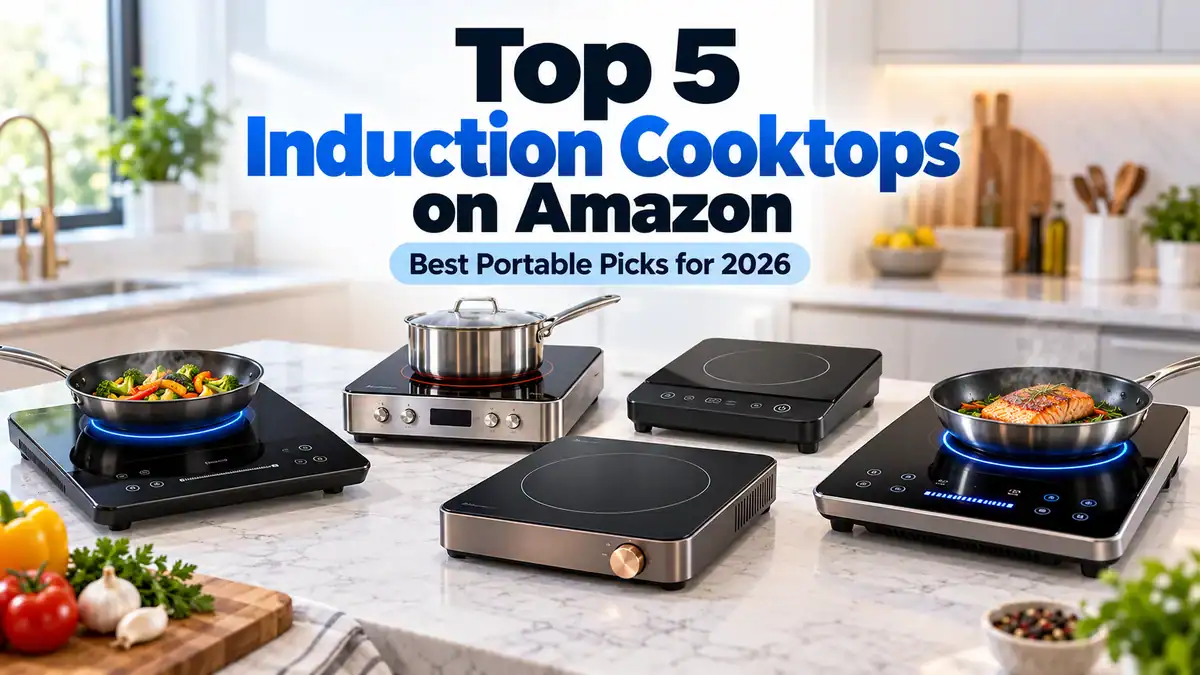
Top 5 Induction Cooktops on Amazon (2026): Best Portable Picks
Updated November 1, 2026. A good portable induction cooktop can be a handy extra burner for a busy kitchen, a compact alternative for a small apartment or a useful cooking tool when your electrical setup permits one. But which model should you choose?
We selected five specific single-burner cooktops sold through Amazon.com and compared their published power controls, temperature settings, construction and suitability for different cooking needs. Our best all-round recommendation is the Duxtop 9610LS, while ChangBERT, Nuwave and AMZCHEF each offer reasons to choose something different.
Disclosure: As an Amazon Associate, we may earn a commission from qualifying purchases at no extra cost to you. AzlinkPRO’s product buttons use the website’s configured Amazon affiliate tracking.
How these were selected: This is a researched buying guide, not a hands-on five-burner laboratory comparison or a live Amazon bestseller ranking. We considered published specifications, safety and electrical requirements, practical cooking controls and available independent reviews. Where a source tested a related model rather than the exact ASIN, we say so.
The Top 5 Portable Induction Cooktops at a Glance
Best overall: Duxtop 9610LS. Best for frequent cooking: ChangBERT CIB-80 Plus. Best for temperature-focused recipes: Nuwave Pro Chef. Best for lower-power setups: Nuwave Gold Precision. Best for low-power flexibility: AMZCHEF 1800W.
| Model | Listed max power | Settings as listed | Current at 120 V |
|---|---|---|---|
| Duxtop 9610LS | 1,800 W | 20 power levels and 20 temperature settings (100°F to 460°F in Duxtop’s manual for this model family) | About 15 A |
| ChangBERT CIB-80 Plus | 1,800 W | 9 power stages from about 200 W to 1,800 W; 18 temperature selections; physical buttons | About 15 A |
| Nuwave Pro Chef | 1,800 W (900, 1,500 and 1,800 W modes) | 94 temperature selections, about 100°F to 575°F in 5°F steps | Up to about 15 A |
| Nuwave Gold Precision | 1,500 W (600, 900 and 1,500 W modes) | Temperature settings from 100°F to 575°F | About 12.5 A |
| AMZCHEF 1800W | 1,800 W | 20 power levels from about 90 W to 1,800 W; 20 temperature choices from about 120°F to 465°F | About 15 A |
Specifications are as published by the manufacturers and listings, not from our testing. Current is calculated as watts divided by 120 V and is only an estimate, so check the rating label. We do not list prices because they change often.
Compare the Five Cooktops
The AzlinkPRO comparison below includes the five exact Amazon products, their useful distinctions and current Amazon product links. Prices and availability can change, so use Amazon’s listing for up-to-date information.
2026 Top Five Portable Induction Cooktops — Amazon Comparison
Compare the key features, then see current product details and pricing on Amazon.
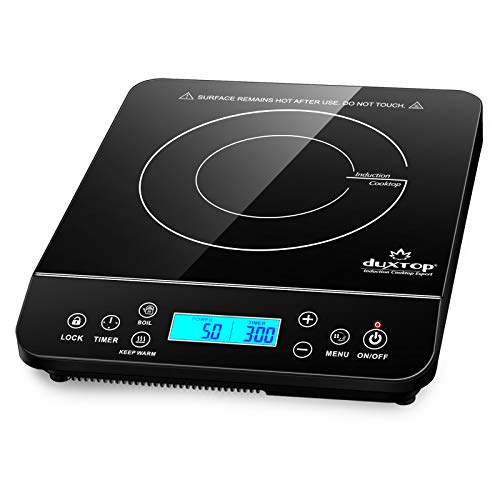
Everyday all-rounder
1800W; 20 power levels
20 temperature settings, up to 460°F
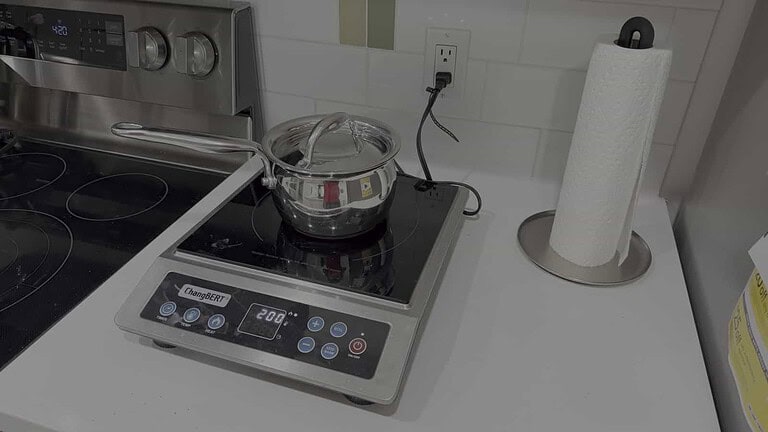
Commercial-style design
1800W; 9 power levels
18 temperatures
Physical push buttons

Temperature-focused recipes
1800W, selectable modes
94 temperature selections 100–575°F
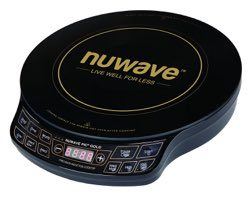
Lower-power setups
1500W maximum
Selectable 600/900/1500W 100–575°F
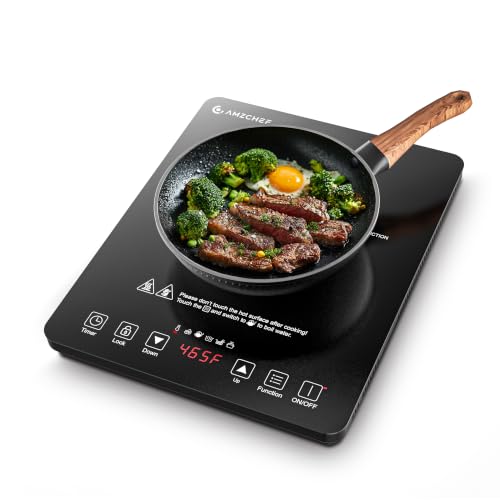
Low-end adjustment
1800W maximum
Advertised 90W minimum
20 power levels
As an Amazon Associate, we may earn a small commission from qualifying purchases.
1. Duxtop 9610LS — Best Overall
Duxtop 9610LS — Best Overall
- 1800W maximum power
- 20 power levels and 20 temperature settings
- LCD sensor-touch display, timer and lock
- Versatile for boiling and everyday cooking
As an Amazon Associate, we may earn a small commission from qualifying purchases.
Amazon ASIN: B07KSNTSVR. See the current listing on Amazon.
The Duxtop 9610LS is our first recommendation for a shopper who wants one portable burner to handle a broad range of everyday tasks. Its 20 power levels and 20 temperature selections make it easier to move between bringing a saucepan to a boil, sautéing vegetables and reducing heat for a simmer. The LCD sensor-touch panel, timer and control lock round out a useful, approachable feature set.
Why the Duxtop 9610LS made the list
One reason to pay attention to Duxtop is its track record. Independent reviewers have evaluated the closely related Duxtop 9600LS (see our Duxtop 9600LS review) and praised its general performance. Those results are helpful background but do not count as tests of the exact 9610LS linked here. Do not assume the displayed temperature is the true temperature throughout your food or skillet.
Who should seriously consider the Duxtop 9610LS?
If you’re buying your first portable induction cooktop, you’re probably wondering whether one small burner can do the jobs you normally handle on a full-size stove. For ordinary day-to-day cooking, the Duxtop’s appeal is that it doesn’t make you choose between simple operation and useful adjustments. You can bring pasta water to a boil, make a skillet dinner, heat soup and prepare a breakfast saucepan without needing to learn a collection of complicated cooking programs.
What I like about this model is the flexibility of its 20 power levels. The shared Duxtop 9600LS/9610LS manual lists levels beginning at approximately 100W and reaching 1800W. That’s more useful than a burner that jumps straight from low to medium to high: you can reduce the output in smaller steps when a sauce begins bubbling too aggressively or when vegetables are browning faster than expected. Of course, more settings don’t guarantee better low-heat stability; that’s a separate performance question.
What are the controls like during a real cooking routine?
The Duxtop has separate power and temperature modes, a readable LCD and dedicated Boil and Keep Warm functions. According to the shared Duxtop 9600LS/9610LS manual, Boil selects maximum power and starts a 10-minute timer, while Keep Warm selects a 140°F target with a 30-minute timer. There’s also an adjustable timer for longer cooking. These shortcuts are handy, but they’re not automatic cooking intelligence: if your pot hasn’t boiled when a preset expires, you’ll need to make another adjustment.
For a pot of rice, soup or sauce, I’d choose power mode first, then reduce it as the food reaches the desired simmer. Temperature mode can be useful as a target, but the cooktop measures or estimates conditions at the appliance rather than inside your food. A thermometer and attention to how the pot behaves remain valuable.
Will my favorite frying pan heat evenly?
This is a better question than asking whether the maximum wattage is high enough. Any portable induction burner has an active coil beneath the glass, and the pan may extend beyond that heated area. If you put a very wide, thin skillet on a compact burner, the center can receive substantially more direct heating than the edges. A flat, magnetic, reasonably heavy-bottomed pan is usually a more promising match than the largest skillet you own. Check the manufacturer’s recommended bottom diameter rather than relying on the pan’s rim measurement.
For pancakes or an oversized sauté pan, I’d be more cautious about promising even browning. For appropriately sized saucepans and medium skillets, the Duxtop’s adjustable output makes more sense. The cooktop also needs clear airflow around its vents, and you’ll hear a fan during or after use.
What would make me choose something else?
The main annoyance I’d anticipate is the sensor-touch control panel. It looks clean and wipes down easily, but people who frequently adjust heat with damp fingers may prefer ChangBERT’s physical push buttons. The second issue is electrical demand: at full output, this is an 1800W appliance, so its circuit requirements deserve attention. A third consideration is evidence. The Duxtop 9600LS has been independently reviewed, but I wouldn’t claim that those test results were measured on this exact 9610LS.
My buying conclusion: This would be my starting shortlist pick for someone who wants a versatile extra burner without paying for unusually specialized controls. If you primarily make sauces at very specific target temperatures, look at the Pro Chef. If you regularly cook with wet hands and want tactile buttons, look at the ChangBERT.
Duxtop 9610LS: Pros & Cons
A balanced first choice for general cooking.
Pros
- 20 power levels More adjustment choices for boiling, sautéing, and simmering.
- 20 temperature settings A broad set of target-temperature selections.
- Clear LCD controls Timer and control lock add convenience.
Cons
- Touch control trade-off Sensor buttons can be less convenient with wet hands.
- Full power needs planning 1800W operation can use much of a 120V 15A circuit's capacity.
- No exact-model test claimed Prominent independent tests are for the related 9600LS.
Based on its published features and the independent review record of the related 9600LS, the 9610LS is a practical all-round choice. Independent test results for the 9600LS should not be treated as direct testing of this exact model.
Before you buy the Duxtop 9610LS
At its maximum 1800W setting, plan around the electrical load. Touch controls are another practical trade-off: they wipe clean easily but may be less convenient with damp or greasy fingers. For someone who mainly needs a dependable and flexible countertop burner, though, this model provides a particularly good combination of features.
2. ChangBERT CIB-80 Plus — Best for Frequent Cooking
ChangBERT CIB-80 Plus — Frequent Cooking
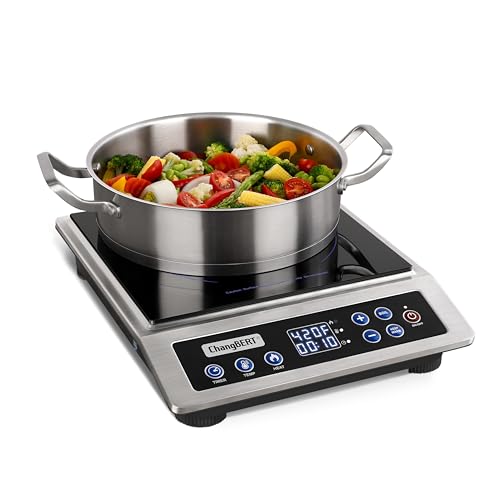
- 1800W maximum and physical push buttons
- 9 power settings and 18 temperature settings
- Stainless-steel housing and max-power shortcut
- Manufacturer advertises 8-inch coil and NSF certification
As an Amazon Associate, we may earn a small commission from qualifying purchases.
Amazon ASIN: B0DDKS56SB. See the current listing on Amazon.
The ChangBERT CIB-80 Plus brings a commercial-style approach to portable induction. It combines a stainless-steel housing, physical push-button controls and an advertised 8-inch induction coil. The manufacturer lists nine power levels and 18 temperature selections, plus a convenient shortcut for maximum output. The construction and control design make it interesting for someone who expects to use a portable burner often.
Why the ChangBERT CIB-80 Plus made the list
Physical buttons are a meaningful difference. Instead of aiming at a small touch area, you can use distinct controls to change settings. The manufacturer also advertises NSF certification, which can matter to buyers considering food-service use; certifications should be confirmed for the exact model and do not establish better cooking performance.
Who benefits from the ChangBERT’s commercial-style design?
Some shoppers aren’t interested in another glossy touchscreen appliance. They want a burner they can set beside the stove, use repeatedly for soups and family meals, wipe down and put away. That’s the attraction of the ChangBERT CIB-80 Plus. The stainless-steel housing and distinct physical buttons make it feel like a kitchen tool aimed at regular work, rather than a gadget built around a display.
The physical buttons are my favorite feature on paper. During cooking, you may need to adjust heat several times as food comes to a boil or a pan begins to sizzle. A button gives you a clear control point without having to tap the right spot on a smooth glass panel. That is a meaningful buying consideration for someone who cooks frequently or finds touch controls irritating.
How well does it fit boiling, stir-frying and larger cookware?
With an advertised 1800W maximum and 8-inch induction coil, the ChangBERT is positioned for tasks that demand reasonably strong heating. The manufacturer describes nine selectable power stages between approximately 200W and 1800W, plus 18 temperature selections. The 8-inch coil claim is worth investigating if you usually cook with medium or relatively broad magnetic-bottom pans: a larger active area can potentially spread direct heating across more of the base. It still doesn’t guarantee even heat in every skillet.
The enhanced Plus version also advertises a one-touch maximum-power function, so you can call up full output without working through the settings. That convenience matters when you’re heating a pot of water, but I’d reduce power as soon as the food needs a controlled simmer rather than leaving the cooktop at full blast. For thin cookware, rapid high heat can make hot spots more apparent.
Are the nine power levels enough?
Nine power settings are plenty for many simple meals, particularly when you tend to change between low, medium and high rather than fine-tune every minute. However, the smallest advertised power setting is around 200W, with relatively wide jumps between some settings. If your main goal is carefully melting delicate ingredients or maintaining a barely moving simmer in a small saucepan, the Duxtop’s broader power scale or AMZCHEF’s lower advertised settings may be more appealing.
ChangBERT also offers temperature mode, but as with every model here, those numbers are selected targets, not proof of the temperature in the pan. Its long timer and commercial certifications are worth noting; the enhanced model’s marketing describes an extended countdown timer and NSF certification. Check that the exact Amazon model carries the certification and timer specification shown in the listing, as the standard CIB-80 and enhanced CIB-80 Plus have different features.
What don’t I like, and is it worth the extra money?
My biggest reservation is value. A stainless-steel enclosure, push buttons and commercial positioning may justify a premium for some shoppers, but they don’t automatically make dinner taste better or guarantee faster heating than a good home-oriented induction burner. There’s also a practical trade-off between tactile simplicity and the limited number of power stages. And although the manufacturer’s extended-use claims sound appealing, I would not turn those claims into an invented endurance test.
My buying conclusion: I’d lean toward ChangBERT for someone who expects frequent use, dislikes touch panels, or needs to check food-equipment certification for a particular application. I’d lean toward Duxtop if fine-grained everyday power settings and a related model’s independent review history matter more. Our full ChangBERT guide covers additional model details.
ChangBERT CIB-80 Plus: Pros & Cons
Commercial-style design with physical controls.
Pros
- Physical push buttons Straightforward operation when adjusting settings mid-cook.
- Stainless-steel housing A commercial-style enclosure suited to frequent handling.
- Max-power shortcut Convenient for rapidly selecting the highest output.
Cons
- Nine power levels Less granular power selection than the Duxtop or AMZCHEF.
- 200W minimum setting May offer less low-end adjustment than models with lower settings.
- Check exact model ChangBERT also sells products with different electrical specifications.
A good feature-based option for cooks who favor physical buttons and a stainless-steel enclosure. Check the exact listing's voltage and certifications before ordering.
Before you buy the ChangBERT CIB-80 Plus
Compared with the Duxtop, this unit offers fewer intermediate power levels, and its stated 200W minimum could be a compromise for some delicate jobs. ChangBERT sells products with differing voltages and specifications, so verify the exact 120V listing before purchasing. For more detail, see our ChangBERT CIB-80 Plus review.
3. Nuwave Pro Chef — Best for Adjustable Temperature Settings
Nuwave Pro Chef — Temperature Control
- 1800W maximum with selectable power modes
- Advertised 94 temperature selections in 5°F steps
- Temperature setting range 100–575°F
- For temperature-focused cooking
As an Amazon Associate, we may earn a small commission from qualifying purchases.
Amazon ASIN: B085J2PQRB. See the current listing on Amazon.
The Nuwave Pro Chef stands out for its advertised temperature controls. The selected model lists 94 temperature selections across approximately 100–575°F, with changes in 5°F steps. It also offers 900W, 1500W and 1800W maximum-power modes. That gives buyers who follow temperature-based recipes more settings to work with than many simpler burners provide.
Why the Nuwave Pro Chef made the list
These controls may appeal to cooks preparing sauces or other dishes that benefit from small adjustments. However, setting the display to a particular temperature does not guarantee that every part of your pan or its contents is at that temperature. Cookware thickness, diameter and the cooktop’s sensors matter. Use a food or oil thermometer when precise measured temperature is important.
Why would you pay attention to 94 temperature settings?
The Nuwave Pro Chef is aimed at a different kind of buyer. If you mainly boil pasta, 94 choices might sound like needless complexity. But if you frequently make delicate sauces, work with small batches or follow recipes that call for selected temperatures, finer adjustments can be useful. Nuwave advertises settings from 100°F to 575°F in 5°F increments, plus six presets, and its manual describes programmable controls.
What appeals to me here is having those choices when you need them, rather than being stuck with only a few broad temperature presets. For example, a recipe calling for gentle warmth and another asking for a much higher searing setting can both be approached from the same control panel. The important qualification is that a five-degree setting increment does not prove five-degree measurement accuracy in your food or pan.
What does that mean for sauces, frying and searing?
For a sauce, I’d use a modest target and watch the actual texture and bubbling rather than assume the display is a precise reading of the sauce. When melting chocolate or preparing temperature-sensitive ingredients, a thermometer or another recipe-appropriate measurement is still the right reference. For frying, the 575°F upper selection provides considerable headroom on the control panel, but it doesn’t mean you should cook every dish at the maximum setting. Your oil’s safe cooking range and the food itself matter more.
Nuwave’s Pro Chef product information also lists an 8-inch coil and ceramic glass cooking surface. As with the ChangBERT, that coil size may be helpful with suitably sized cookware, but the quality and thickness of your skillet still affect how evenly the heat spreads.
The wattage button is almost as useful as the temperature range
It’s easy to overlook the Pro Chef’s 900W, 1500W and 1800W maximum-wattage modes. Those settings make this a flexible choice when you don’t always need full power. In a kitchen with a suitable circuit, you may want 1800W for faster heating and a lower limit for less demanding tasks. In a smaller power setup, selectable wattage can make planning easier, provided the complete electrical system meets the manual’s requirements.
The Pro Chef also offers preset temperatures and the ability to make changes during a cooking program. That could matter if you regularly prepare the same recipe in stages. Someone who never uses programming, however, is paying attention to features that may not improve their own cooking routine.
What are the drawbacks before placing an order?
The first drawback is simply learning the controls. Between preset choices, temperature increments, a programming function and selectable wattage, there’s more to understand than on a straightforward burner. Second, the apparent precision can be misleading. Portable induction burners measure and regulate heat indirectly, and pan construction, quantity of food and power cycling affect the result. Third, the Pro Chef’s high advertised maximum temperature isn’t a substitute for controlled comparisons of simmering or heat distribution.
My buying conclusion: The Pro Chef belongs high on the list if your cooking genuinely benefits from fine target-temperature choices and programming. If you cook quick lunches, pasta and vegetables with simple power adjustments, the Duxtop may be a more straightforward choice. I’d buy the Pro Chef for its control flexibility—not because 94 settings automatically mean better cooking.
Nuwave Pro Chef: Pros & Cons
A range of target-temperature selections.
Pros
- 5°F temperature steps Advertised 94 selections from 100 to 575°F.
- Selectable wattage Offers 900W, 1500W and 1800W maximum modes.
- Programmable features Useful for cooks who regularly use temperature-specific recipes.
Cons
- More complex controls Many selections can be unnecessary for basic meals.
<