Induction Cooktops and Pacemakers: What the Research and Device Makers Say
If you or someone in your house has a pacemaker or an implantable defibrillator (ICD), it’s smart to ask about induction before you buy. Induction works by making a magnetic field, and that’s exactly the kind of thing heart devices are designed to watch out for.
The good news: most people with modern heart devices can cook on induction with a few simple habits. Here’s what the studies found, what device makers recommend, and the practical steps that keep the risk low.
Important: I’m not a doctor, and this isn’t medical advice. Every device and every person is different. Check with your cardiologist or device clinic before you use an induction cooktop, and ask them for the guidance that matches your specific device.
The short answer
- Medtronic, one of the largest device makers, lists induction cooktops in its “keep 24 inches (60 cm) away” category.
- Harvard Health suggests keeping 12 to 24 inches between the device and the cooktop.
- Lab research found the highest risk when the pot is off-center, the person leans right over the cooktop, and the device is an older unipolar type implanted on the left side.
- Keeping the pan centered and keeping some distance made a big difference in the studies.
Why induction can matter for heart devices
An induction cooktop runs a coil under the glass that creates a rapidly changing magnetic field. That field heats your pan. Most of it stays right around the coil and the pan, but some leaks out, especially around the edges of the cooking zone. If you want the deeper science, my post on how induction cooking works explains it.
A pacemaker or ICD reads tiny electrical signals from your heart. A strong enough outside field could, in theory, be mistaken for a heart signal. That’s called electromagnetic interference, or EMI. It could cause a pacemaker to hold back a beat, or an ICD to misread a rhythm. Modern devices have a lot of filtering built in, which is why the real-world risk is low. But “low” isn’t “zero,” which is why distance guidance exists.
What the research found
The best-known study, by Irnich and colleagues, tested 11 European induction cooktops using a worst-case model of a left-sided, unipolar pacemaker. With a large pot placed off-center, they measured induced voltages up to 800 mV, which is high enough to matter. Moving to 35 cm (about 14 inches) away always brought it down to 60 mV or less.
Their conclusion was that patients are at risk mainly when three things line up: the implant is unipolar and on the left side, the person stands as close as possible, and the pot isn’t centered on the coil. They also noted that pacemaker-dependent patients were less affected in this scenario, because of how the device responds.
A 2005 study by Hirose and colleagues tested four unipolar pacemakers with an induction oven and found interference up to 34 cm away for one device. They suggested 50 cm (about 20 inches) or more as a safe distance.
Two caveats. These are lab studies with models, not people cooking dinner. And they mostly focused on unipolar pacemakers, which are less common today than bipolar ones. The research on ICDs specifically is thinner, which is one reason device makers stay conservative.
What device makers and doctors recommend
- Medtronic: lists induction cooktops under its 24-inch (60 cm) distance guidance, and its ICD guidance says to keep two feet between the device and the cooktop.
- Harvard Health: suggests 12 to 24 inches, and recommends checking with your cardiologist.
- Biotronik: says interference is unlikely at its specified distance in its patient EMI guide.
- Some appliance makers are more cautious. Beko’s UK support page, for example, advises people with pacemakers to avoid induction hobs. Check your cooktop’s manual; many include a pacemaker warning.
So the numbers range from about 12 to 24 inches. If you take one thing away, it’s this: 2 feet is the conservative figure that most guidance lands on, and your device maker’s guidance wins over anything here.
Practical tips if you have a pacemaker or ICD
- Center the pan on the zone. Off-center pots leak more field. This was the single biggest factor in the lab.
- Match pan size to the zone. A small pan on a big zone leaves more of the field uncovered.
- Don’t lean over the cooktop. Stir with a long spoon and step back between steps.
- Use the back burners. They add natural distance from your chest.
- Don’t rest against the cooktop or counter edge while it’s on.
- Turn the zone off before taking the pan off.
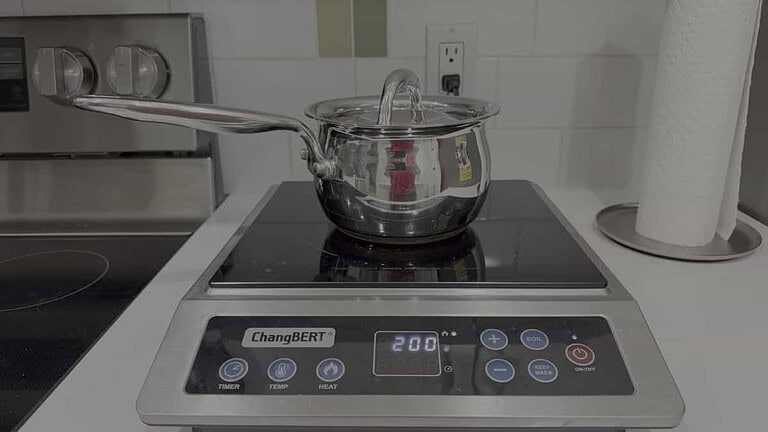
- Portables count too. A countertop burner sits closer to chest height than you might think, especially on a high counter or table. Keep the same distance.
- Tell your device clinic you’re using induction. They can check your device’s settings and history at your next visit.
Signs to call your doctor
If you feel dizzy, lightheaded, short of breath, notice palpitations, or get a shock from an ICD while near the cooktop, step away right away and contact your doctor or device clinic. If symptoms are severe, call 911.
Is gas a safer choice?
For pacemaker EMI alone, yes, gas and radiant electric don’t produce the same magnetic field. But gas has its own downsides indoors, like combustion byproducts and burns. I compared them in induction vs gas. If your cardiologist is fine with induction at a distance, most people find it easy to work with.
Other implants and conditions
- Insulin pumps, neurostimulators, cochlear implants: these are electronic too. Ask the device maker for their EMI guidance.
- Metal joints and plates: generally not an issue at normal cooking distances, but check if you’re unsure.
- Pregnancy: a separate question; see is induction cooking safe during pregnancy.
For the general safety picture, including burns, kids and EMF, see are induction cooktops safe.
Quick FAQ
Can I use induction with a pacemaker?
Many people do, with distance and a centered pan. Your cardiologist should make the call for your device.
How far should I stand from an induction cooktop?
Guidance runs from 12 to 24 inches. Medtronic uses 24 inches (60 cm). When in doubt, go with 2 feet.
Is it riskier with an ICD than a pacemaker?
The research mostly tested pacemakers. ICD makers lean conservative because a misread rhythm could mean an unneeded shock. Follow your ICD maker’s guidance.
Does it matter if the cooktop is off?
The magnetic field only exists while a zone is heating a pan. Harvard’s guidance mentions keeping distance either way, which is an easy habit to keep.
The bottom line
Induction and heart devices can usually coexist. Center your pan, use the back zones, keep about two feet between the cooktop and your chest, and don’t lean over the glass. Most importantly, talk to your cardiologist or device clinic before you start, and follow your device maker’s guidance over anything you read online, including this.
Sources
- Irnich et al., Do induction cooktops interfere with cardiac pacemakers? (Europace, PubMed)
- Hirose et al., Electromagnetic interference of implantable unipolar cardiac pacemakers by an induction oven
- Harvard Health: Pacemaker precautions in the age of electrification
- Medtronic: ICDs and household appliances
- Medtronic patient EMI brochure (PDF)
- Biotronik: Electromagnetic Interference Guide (PDF)
- Beko UK: induction hobs with pacemakers and implants
- Tom’s Guide: cardiologists on induction and pacemakers