Are Induction Cooktops Safe? Key Facts and Precautions
As an Amazon Associate, we may earn a small commission from qualifying purchases.
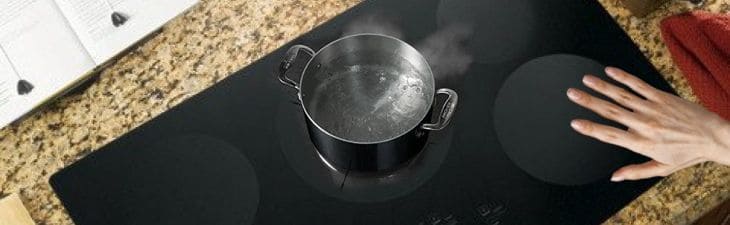
Are induction cooktops safe? Yes, they can be used safely when installed and operated according to the manufacturer’s instructions, but they are not burn-proof. Can you burn yourself on an induction stove? Yes: the pan gets hot, and heat from the pan can make the glass surface hot even after the cooktop stops actively heating. Many models detect removed cookware, but you should still switch off the appliance and supervise cooking.
Last reviewed: November 1, 2026. This guide summarizes published measurements and guidance. We have not measured fields ourselves.
Key points
- Burns are the everyday risk. The pan, the food and the glass can all stay hot, and the glass can stay hot after the pan is lifted.
- Fields: induction hobs produce non-ionizing magnetic fields at tens of kilohertz. In Swiss Federal Office of Public Health (FOPH) measurements, fields were no more than 6.25 µT at 30 cm with standard pots, but much higher within a few centimetres of the glass and with off-center pans.
- Pacemakers and ICDs: guidance we found ranges from 60 cm (British Heart Foundation) to 12 to 24 inches (Harvard Health). Ask your care team and device maker.
- Efficiency: ENERGY STAR cites about 85% heat-transfer efficiency for induction, 75 to 80% for resistance electric and about 32% for gas.
See also: How does induction cooking work? and best portable induction cooktops.
What is an Induction Cooktop?
An induction cooktop is an electrical appliance with a coil under a glass-ceramic surface. The coil’s changing magnetic field heats compatible cookware directly, so there is no flame and no glowing element.
Because the pan itself is the heat source, less energy is lost to the air around it. ENERGY STAR gives approximate heat-transfer efficiencies of about 85% for induction, 75 to 80% for conventional resistance electric and about 32% for gas, and says induction reaches temperature quicker. Real-world efficiency still depends on the cookware, power setting and task. Induction changes power quickly, which helps with precise cooking, but food can still burn if the heat is too high or the pan is left unattended.
AzlinkPRO: Legacy Portable Induction Cooktops and Cookware
Compare the key features, then see current product details and pricing on Amazon.
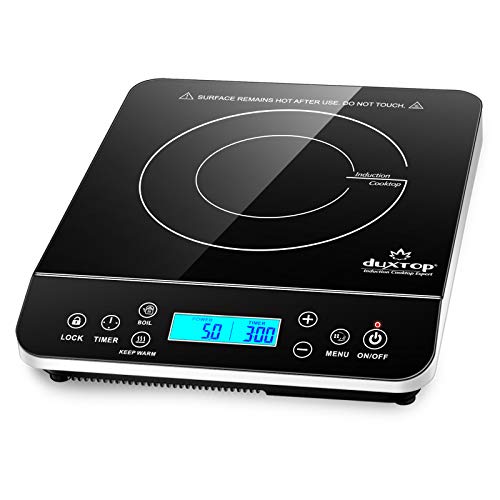
Compare model controls, power rating, compatible cookware and current availability

Compare model controls, power rating, compatible cookware and current availability
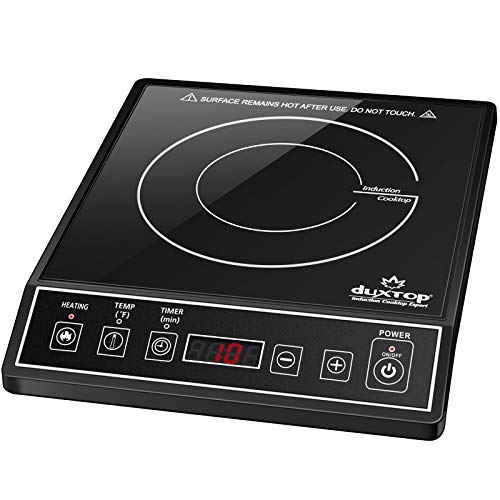
Compare model controls, power rating, compatible cookware and current availability

Compare model controls, power rating, compatible cookware and current availability

Compare model controls, power rating, compatible cookware and current availability

- Verify induction compatibility
As an Amazon Associate, we may earn a commission from qualifying purchases.
How Do Induction Cooktops Work?
An induction cooktop sends alternating electrical current through a coil beneath the glass. The changing magnetic field induces currents in compatible cookware, generating heat in the pan. The pan gets hot, and its heat can warm the glass surface indirectly.
The pan gets very hot through this electromagnetic induction process, and suitable cookware can include cast iron, some stainless steel and pans with an induction-compatible magnetic base. Heating happens quickly, which is why induction cooking is speedy and efficient.
How the Magnetic Field Heats Cookware
The coil carries alternating current at tens of kilohertz. The Swiss Federal Office of Public Health (FOPH) reports induction-hob frequencies of about 18 to 22 kHz at maximum power and about 42 to 63 kHz at lower settings, and the EMF-Portal database lists 20 to 100 kHz for induction cooktops generally. EMF means electromagnetic field. It describes the field around the coil, not a current flowing through a person.
Like every electrical appliance, an induction cooktop has electrical hazards and produces electromagnetic fields. How much that matters depends on field strength, frequency, distance and duration, not on whether a field exists. Anecdotes are not reliable evidence of health effects, so this guide relies on measurements and public-health guidance, starting with the WHO overview of electromagnetic fields.
Are Induction Cooktops Safe?
Electric fields come from voltage, and magnetic fields come from current. The higher the current, the stronger the magnetic field around the conductor.
An electric field exists whenever a device is energized, even if no current is flowing. When current flows, the magnetic field grows with it, so it changes with the power setting, while the electric field depends on the voltage and is largely unaffected by the power setting. The magnetic field is the one that matters most for induction.

Do induction cooktops emit radiation?
Yes, but not the kind that damages cells directly. The coil under the glass acts as an electromagnet, and the magnetic field it creates heats the pan. Induction cooktops produce non-ionizing, intermediate-frequency magnetic fields, not ionizing radiation such as X-rays. They also work differently from microwave ovens, so conclusions about one should not be applied automatically to the other. Exposure varies with distance, power level and pan placement.
What do the measurements show?
| Source | What it reports |
|---|---|
| Swiss Federal Office of Public Health fact sheet (dated 2006, revised 2007) | Frequencies of about 18 to 22 kHz at maximum power and about 42 to 63 kHz at lower settings. Measured fields of up to roughly 13 to 38 µT at 1 cm, and no more than 6.25 µT at 30 cm with standard pots. Off-center pots increased the field. |
| EMF-Portal (research database) | Frequency of 20 to 100 kHz. Individual studies list values from 0.7 µT at 235 mm and 5 µT at 20 cm up to 20 µT at 30 cm (maximum, at 20 kHz). One study found about 47.8 µT with an off-center pan versus about 7.46 µT with a centered pan at the surface. |
These figures differ because hobs, pans, power levels and measurement positions differ. The Swiss fact sheet compares its results with the 1998 ICNIRP general-public reference level of 6.25 µT for 3 to 150 kHz. It reports that this level was exceeded close to the hob, at roughly 1 to 5 cm and in worst cases up to 9 to 19 cm, and that a centered, correctly sized pan lowers the field. ICNIRP has since revised its low-frequency guidelines (2010), so check the current document for today’s reference levels. A microtesla (µT) is a unit of magnetic flux density.
The practical takeaway: field strength falls quickly with distance, and pan size and position matter. Use a pan that matches the cooking zone, keep it centered, and avoid leaning against the hob while it is running.
Is induction cooking harmful to health?
There is no established evidence that ordinary, properly used induction cooking causes the serious illnesses sometimes claimed online. The World Health Organization explains that health implications depend on the type of field and the exposure, and that research continues, so evidence about one technology should not be assumed to apply to another. Magnetic-field exposure from a hob depends on cookware size, placement and distance, which is why a centered, correctly sized pan matters. The Swiss fact sheet we read gives no specific recommendation for people with implants, so see the device guidance later in this guide.
The more common harm is thermal. Induction has no open flame and often has pan detection, and it does not heat a conventional radiant element. But cookware, food and splashes can still burn you, and the glass warms from the pan. Safe use needs suitable cookware, ventilation, attention and the manufacturer’s precautions. Related reading: why cooking on induction still benefits from ventilation.
Are induction hobs safe to touch?
Not always, and yes, you can burn yourself. A changing magnetic field generates heat mainly in the compatible cookware, not in the glass. But the hot pan transfers heat to the glass by contact, and the glass may stay hot after cookware is removed or the burner is switched off. Avoid touching the cooking zone until it cools, and follow any residual-heat warning. Manufacturers such as LG Canada explicitly warn that induction surfaces can become hot from the pan. Induction is also not free of cooking fires, so normal kitchen precautions apply.
Learn how your cooktop works before first use, and see our guide to induction cooking during pregnancy for a related safety question.
How can you tell if cookware is induction compatible?
Important: Do not use touch to test whether an induction cooktop is heating. Compatible cookware can heat quickly, and a hot pan can also make the cooktop glass unsafe to touch even when there is no open flame.
The simplest screening test is a magnet held against the flat bottom of the pan. Strong attraction usually means a magnetic base, which cast iron and many stainless steels have. If a magnet does not stick, the pan generally will not heat on an induction zone. A magnet alone does not prove full compatibility, so also check the cookware label and your cooktop’s minimum pan diameter. For more, see our induction-ready cookware guide. If the cooktop is not heating correctly with suitable cookware, contact the manufacturer about repair options.
Practical safety tips
Beyond the basics above, these habits reduce risk on any induction cooktop, portable or built in:
- Never use the portable induction cooktop without a pot or pan placed on it.
- Dry the bottom of pans before placing them on the surface, and keep water and spills away from the controls and vents. Liquids that get into the unit can damage it or create an electrical hazard, so follow your manual’s cleaning guidance.
- Do not let the cord to the induction cooktop hang over the edge of a countertop.
- Do not leave metal items such as knives, utensils or foil on the cooking surface while it is on, because magnetic metal can heat up.
- Make sure you unplug the induction cooktop when not in use.
- If your portable induction cooktop starts to act up, you should stop using it and contact the manufacturer. Your unit may need to be repaired or replaced altogether.
- The surface of the induction system can get hot enough to cause burns, so do not touch the surface until it has cooled down.
- Stay within the pan size and weight limits in your manual. Overloading a portable unit with an oversized or very heavy pot can damage it or make it unstable.
Electric Fields vs. Magnetic Fields
At the low frequencies used by household appliances, electric and magnetic fields are usually measured and assessed separately: electric fields in volts per metre (V/m) and magnetic fields in microtesla (µT). EMF-Portal lists a maximum electric field of about 220 V/m in the middle of a hob, so for induction the magnetic field is usually the focus. At much higher frequencies, electric and magnetic fields travel together as electromagnetic radiation, such as radio waves and light.
Electromagnetic fields also occur in nature, including the earth’s own fields and sunlight, which includes ultraviolet light and visible light. Ultraviolet light carries far more energy per photon than the low-frequency, non-ionizing magnetic fields of an induction cooktop, so the two exposures should not be treated as having the same health effects.
Related Topic: Induction Cooktop FAQ
What Does the Evidence Say About EMF Exposure?
Electromagnetic fields occur around household wiring, electrical appliances and wireless equipment, but frequencies, strengths and exposure patterns differ. Their biological effects depend on frequency, intensity and duration, so evidence about one source cannot automatically be applied to induction cooktops. All electrical appliances generate electromagnetic fields. X-rays use ionizing radiation, and MRI uses strong static magnetic fields with radiofrequency pulses. Neither is a substitute for evidence about induction-hob exposure, so follow guidance specific to induction appliances.
What Does the Research on Low-Frequency Magnetic Fields Mean?
Research into extremely low-frequency magnetic-field exposure near electrical infrastructure has reported some statistical associations with childhood leukaemia. These studies are not direct evidence about induction cooking, which involves different frequencies, distances and exposure patterns.
The International Agency for Research on Cancer classified extremely low-frequency magnetic fields as possibly carcinogenic to humans (Group 2B), based on limited evidence. This classification is not a finding that all electromagnetic fields, or induction cooktops specifically, cause cancer. See the U.S. National Cancer Institute’s evidence overview.
Research Limitations and Practical Precautions
Research on low-frequency fields and long-term health outcomes continues. Some epidemiological findings have been difficult to interpret, and an observed association does not establish causation. Findings about power lines or other sources should not be generalized to induction cooktops, because frequency, proximity and exposure levels differ. Scientific findings should be read for the specific exposure involved, rather than declaring every concern baseless or assuming all devices carry the same risk.
Exposure depends on field strength, frequency, distance and duration. The measurements above suggest three practical habits: use a pan that fits the cooking zone, keep it centered, and stay a little back from a hob that is running at high power. People with implanted medical devices should follow the guidance below and ask their clinician.
Conclusion: Using an Induction Cooktop Safely
Induction offers real safety advantages, such as no open gas flame and pan detection on many models, but cookware and glass can still cause burns and the surface may not be cool after cooking. Keep children away from hot zones and follow the manufacturer’s safety instructions. The fields are non-ionizing and fall off quickly with distance, which makes pan size, pan position and distance the practical levers. Metal utensils do not conduct an induction current through your body, though utensils and pan handles can become hot.
Pacemakers and implanted heart devices: what the guidance says
| Source | What it says |
|---|---|
| British Heart Foundation (Dr Mike Knapton, Associate Medical Director; page undated) | Keep at least 60 cm (2 ft) between the stovetop and your pacemaker. Most people should be able to use a hob if they follow these precautions, and if you are buying a new cooker it may be easier to pick one that is not induction. The page covers pacemakers only. |
| Harvard Health Publishing (Julie Corliss; reviewed by Christopher P. Cannon, MD; May 1, 2023) | Keep 12 to 24 inches between an induction cooktop and an implanted pacemaker or ICD, whether the cooktop is on or off. |
| Biotronik electromagnetic interference guide (document MI209r1, September 16, 2022) | Lists induction cooktops among household appliances where interference with the implanted device is possible. It gives no distance for induction cooktops. |
Pacemakers and other implanted heart devices: Follow the advice for your specific device. For example, Medtronic Canada’s electromagnetic compatibility guide advises keeping a distance of 24 inches (about 60 cm) from induction cooktops. Ask your cardiology team and your device manufacturer about any individual precautions before use.
For normal cooking, use appropriately sized magnetic cookware centered over the active zone and keep the clearances in the appliance manual. Guidance for specific medical devices and product models may differ, so ask your cardiology team and the device maker. Our induction versus electric comparison explains practical differences between heating methods.
Cast iron is generally induction-compatible because it is magnetic. Rough or heavy pans can mark a glass-ceramic surface if dragged across it, so lift cookware rather than sliding it, keep the base clean, and check the manufacturer’s pan-size and surface-care recommendations.
Frequently asked questions
Are induction cooktops safe?
Yes, when installed and used according to the manufacturer’s instructions. Burns from hot cookware and glass are the everyday risk, and people with pacemakers or ICDs should follow their clinician’s and device maker’s advice.
Do induction cooktops give off dangerous radiation?
They produce non-ionizing magnetic fields at tens of kilohertz, not ionizing radiation like X-rays. In the Swiss FOPH measurements the field was no more than 6.25 µT at 30 cm with standard pots, but it was much higher within a few centimetres of the glass.
How far should I stand from an induction cooktop?
There is no single official distance for everyone. For pacemakers and ICDs, guidance we found ranges from 60 cm (BHF) to 12 to 24 inches (Harvard Health). Fields fall off quickly with distance, so stepping back from a hob running at high power helps.
Is induction more efficient than gas or electric?
ENERGY STAR cites about 85% heat-transfer efficiency for induction, 75 to 80% for resistance electric and about 32% for gas. Real-world results depend on cookware and cooking habits.
Sources
- ENERGY STAR: induction cooking tops (retrieved November 1, 2026)
- Swiss Federal Office of Public Health: induction hob magnetic field fact sheet (2006, revised 2007)
- EMF-Portal: induction cooktops (retrieved November 1, 2026)
- World Health Organization: radiation and electromagnetic fields
- U.S. National Cancer Institute: electromagnetic fields fact sheet
- Pacemaker guidance: BHF, Harvard Health Publishing and Biotronik, linked in the table above