Best Portable Induction Cooktop for RVs (2026): Picks for Shore Power, Generators and Inverters
As an Amazon Associate I earn from qualifying purchases. It doesn’t change what I recommend.
Best Portable Induction Cooktops for RVs
Compare the key features, then see current product details and pricing on Amazon.

Wattage caps: 600, 900 or 1300W
Compact 10.25-inch glass
Easiest on inverters and 30A
Best for most RVs
Three wattage caps up to 1500W
Bigger 8-inch coil
Temps from 100°F to 575°F
Best for bigger pans
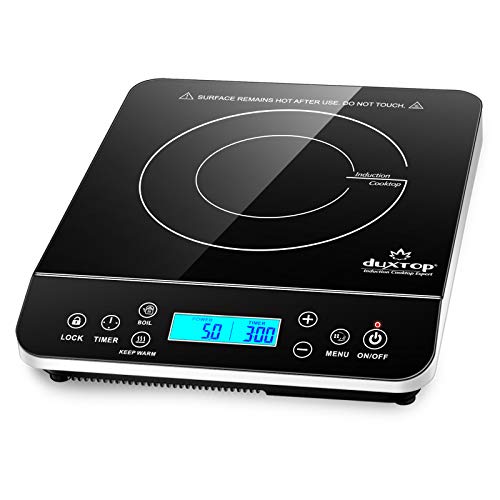
Full 1800W
20 power levels, down to 100W
Long 10-hour timer
Best on shore power
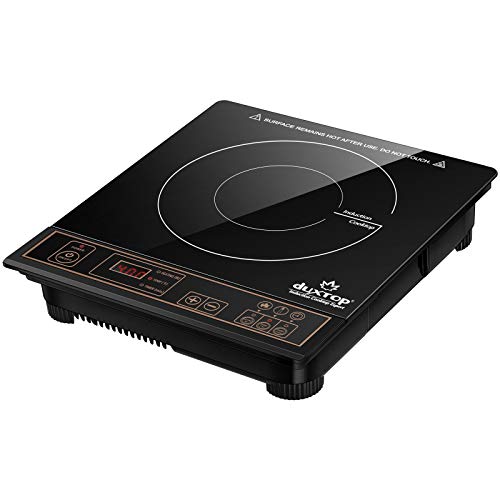
1800W, push buttons
Simple and tough
Usually the cheapest
Best budget
As an Amazon Associate, we may earn a small commission from qualifying purchases.
A portable induction burner is one of the best upgrades you can make to an RV kitchen. No propane smell, no open flame, no extra moisture in a tiny space, and the glass wipes clean in seconds. But in an RV, the burner isn’t the hard part. Power is.
The right pick depends on how you camp: full hookups, a generator, or boondocking off batteries and an inverter. Here’s how to match a burner to your power, with real numbers, and the ones I’d buy for each setup.
Quick picks
- Best for most RVs: Nuwave Flex. A hard wattage cap of 600, 900 or 1300W keeps it friendly with inverters and 30-amp hookups.
- Best for bigger pans: Nuwave Gold. Larger 8-inch coil, caps up to 1500W.
- Best on shore power or a generator: Duxtop 9600LS. Full 1800W and fine low-end control.
- Best budget: Duxtop 8100MC. Simple, tough, cheap.
First, know your power
30-amp shore power
A 30-amp RV hookup gives you about 3,600 watts total (120V × 30A). A rooftop air conditioner can use well over 1,000 watts on its own, and a microwave or water heater on electric adds more. Add an 1800W burner and you can trip the pedestal breaker fast. That’s why a burner with a wattage cap is so handy on 30 amps.
50-amp shore power
A 50-amp hookup has two 50-amp legs, about 12,000 watts total. You can usually run a full 1800W burner without thinking about it, as long as it’s not on the same branch circuit as another big load. The outlet itself is still a 15 or 20-amp circuit inside the rig.
Generator
A common 2,000 to 2,200-watt inverter generator can run an 1800W burner, but there’s not much left over. Set the burner to a lower power level, or pick one with a wattage cap, and run one big load at a time.
Batteries and an inverter
This is where most people get surprised. At 12 volts, an 1800W burner pulls roughly 150 amps from the battery, plus about 10% more for inverter losses. That’s a lot of current. Here’s what it looks like for a typical 15-minute cooking session:
| Setting | Battery draw at 12V (approx.) | 15 minutes uses | Inverter size I’d want |
|---|---|---|---|
| 600W | ~55A | ~14Ah | 1,000W+ |
| 900W | ~83A | ~21Ah | 1,200W+ |
| 1300W | ~120A | ~30Ah | 1,600W+ |
| 1800W | ~165A | ~41Ah | 2,000W+ (pure sine) |
A 100Ah lithium battery gives you roughly 1,200 to 1,280 watt-hours, so that’s about five 15-minute sessions at 900W before it’s empty, with nothing else running. With lead-acid you only want to use about half its capacity, so cut that in half. Use a pure sine wave inverter; modified sine inverters can make induction burners noisy or unreliable. For more on this, see battery-powered induction cooktops and portable induction electrical requirements.
Why a wattage cap matters
Most burners let you pick a power level, but a level isn’t always a hard limit, and some start at full power before settling. Nuwave’s wattage setting is a ceiling: set it to 900W and that’s the most it’ll draw. On a small inverter or a busy 30-amp circuit, that’s the difference between dinner and a tripped breaker.
1. Nuwave Flex: best for most RVs
Nuwave Flex Precision Induction Cooktop
- Pick a wattage cap of 600, 900 or 1300 watts, so it never pulls more than your rig can give
- Nuwave's manual lists a draw of up to about 10.8 amps at full power
- Small 10.25-inch glass top that fits RV counters
- 45 temperature settings from 100°F to 500°F
As an Amazon Associate, we may earn a small commission from qualifying purchases.
Nuwave Flex for RVs: Pros & Cons
The easiest induction burner to live with off a small inverter or 30-amp hookup.
Pros
- Hard wattage cap Set it to 600 or 900 watts and it stays there, so it won't trip a small inverter or a shared 30A circuit.
- Small and light The 10.25-inch top fits tight galley counters and stores in a drawer.
- Temperature control 45 settings from 100°F to 500°F, good for eggs, rice and simmering.
Cons
- Small coil The 6.5-inch coil heats the center of a 12-inch pan much more than the edges.
- 1300W max Slower to boil a big pot of pasta water than an 1800W Duxtop.
- Not a battery unit It runs on 120V AC. Off-grid, you still need an inverter sized for it.
For boondocking with an inverter or sharing a 30-amp hookup with the AC, this is the one I'd pack.
The Flex is small, light and built around those three wattage caps. Nuwave’s manual lists a draw of up to about 10.8 amps at full power and says it’s meant for 120V AC, not direct battery power. Its default is 1300W, so on an inverter, press the Watts button down to 600 or 900 before you start. It’s usually one of the most affordable Nuwave models.
- Buy it if: you boondock with an inverter, share a 30-amp hookup, or have a tight galley.
- Skip it if: you cook with big 12-inch pans or boil big pots often.
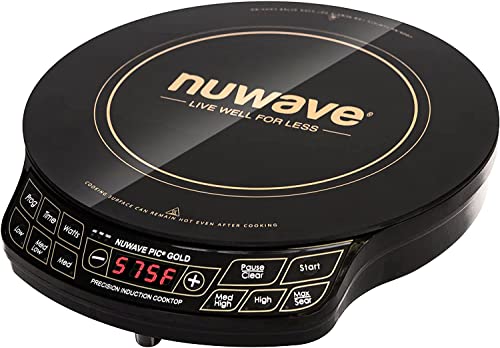
2. Nuwave Gold: best for bigger pans
Nuwave Gold Precision Induction Cooktop
- Three wattage settings topping out at 1500 watts
- Larger 8-inch heating coil for 10- and 12-inch pans
- Temperatures from 100°F up to 575°F for real searing
- 12-inch cooking surface that's still easy to stash
As an Amazon Associate, we may earn a small commission from qualifying purchases.
The Gold steps up to an 8-inch coil and a 12-inch surface, which spreads heat better under a 10 or 12-inch skillet. It keeps the wattage caps, topping out at 1500W (older versions list 600/900/1500; newer ones 700/900/1500). It goes up to 575°F, so searing a steak is no problem. I went deeper in my Nuwave PIC Gold review.
- Buy it if: you cook real meals for two or more and have the power for 1500W.
- Skip it if: storage space is tight; it’s noticeably bigger than the Flex.
3. Duxtop 9600LS: best on shore power
If you’re mostly at campgrounds with 50-amp service, the Duxtop 9600LS gives you the full 1800 watts, so it boils faster than the Nuwaves. It also goes down to 100W for simmering, has 20 power levels and a timer up to 10 hours. It doesn’t have a separate wattage cap, but you can run it in power mode at a lower level on a generator. Comparing Duxtops? See Duxtop 9600LS vs 9100MC vs 8100MC.
4. Duxtop 8100MC: best budget
The Duxtop 8100MC is the cheap, tough option with physical push buttons, which are nice when the RV is bouncing around and you’re cooking with wet hands. Same 1800W max, 10 power levels from 200W. Best for hookups and generators, not small inverters.
Induction vs propane in an RV
- Air quality: no combustion, so no added moisture or combustion gases in a small space. Condensation is a real problem in RVs, and propane cooking adds to it.
- Heat: induction puts much less heat into the cabin. Nice in summer.
- Cost: on hookups, electricity is usually included in your site fee, so induction cooking is basically free versus refilling propane.
- Off-grid: propane wins when you have no power to spare. Many people keep both.
More on the trade-offs in induction vs gas.
RV-specific tips
- Check your cookware. A lot of RV pans are lightweight aluminum. Do the magnet test; see how to tell if cookware is induction ready.
- Keep the vents clear. Don’t tuck it into a cabinet or against a wall while it’s running.
- Stop sliding. A silicone mat helps on an unlevel site; see induction protector mats.
- Store it safely. Pack it in its box or a padded bag so the glass doesn’t crack on the road.
- One big load at a time. Don’t run the burner, AC and microwave together on 30 amps.
- Check campground rules. Some places limit outdoor cooking appliances.
Cost to cook
On a metered site at 17 cents a kWh, a 20-minute meal at 1300W uses about 0.43 kWh, or roughly 7 cents. On included hookups, it’s free. Off-grid, the real cost is battery capacity, which is why the wattage cap matters more than the purchase price.
My pick
For most RVers, I’d get the Nuwave Flex. The 600/900/1300W cap makes it the easiest burner to live with on 30 amps, a small generator or an inverter. If you’re usually on 50-amp hookups and cook bigger meals, the Duxtop 9600LS is the better cooker. For even more options, see my best portable induction cooktops roundup.
Sources
Based on manufacturer manuals and listings and owner reviews, not hands-on testing by this site. Power figures are estimates; check your rig’s specs.