Portable Induction Cooktop Electrical Requirements: 120V, 15A and 1,800W
A North American portable induction cooktop rated for 1,800 watts at 120 volts is a high-demand countertop appliance. Some models are explicitly designed for a 120-volt, 15-amp outlet, and manufacturers often call for an appropriate wall receptacle without other appliances sharing the load. The exact requirements come from your cooktop’s label and manual, not from a generic statement that all induction burners are the same.
This guide explains the ratings so buyers can choose an appropriate product. It is not a wiring or circuit-modification tutorial. For uncertainty about a home’s receptacle, electrical protection or circuit capacity, consult a licensed electrician.
Understanding the appliance label
| Rating | Meaning | Why it matters |
|---|---|---|
| 120 V | Nominal supply voltage | The appliance must match the power supply for which it is approved |
| 15 A | Electrical current rating in amperes | Helps identify the outlet and circuit requirements specified by the manufacturer |
| 1,800 W | High/maximum rated power on some units | Indicates substantial electrical demand when operating at full power |
In basic electrical terms, a 1,800-watt load at 120 volts corresponds to 15 amperes. That arithmetic does not establish whether a particular home’s wiring or circuit is suitable, nor does it guarantee that an appliance continuously draws maximum power. Real current and power depend on the design, settings and operating state.
What do portable induction manuals actually require?
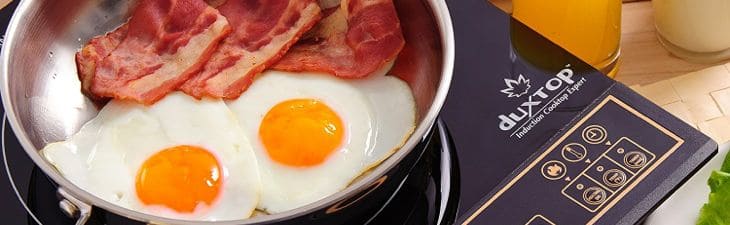
Secura’s Duxtop 9600LS manual specifies a 120 V, 15 A outlet and advises against sharing the outlet with another electrical appliance. It also specifies ventilation clearance and other placement conditions. These are model-specific instructions; check any different burner rather than transferring those numbers automatically. For the appliance’s other considerations, consult our Duxtop 9600LS review and induction manuals directory.
The manufacturer should state whether a dedicated circuit is required, whether normal household receptacles are allowed, whether an extension cord is prohibited, and what installation restrictions apply. A built-in 240-volt induction cooktop follows a different installation standard from many portable countertop units.
Why sharing an outlet can cause problems
High-demand appliances may compete for electrical capacity with other devices. An overloaded or unsuitable setup can trip protection devices or create overheating hazards. The Electrical Safety Foundation International recommends plugging major appliances directly into a wall receptacle and warns that power strips add sockets, not circuit capacity.
Do not use a power strip or improvised adapter to work around a manufacturer’s electrical requirements. If a suitable fixed outlet isn’t available, the safe solution is an assessment by a qualified professional, not homemade changes to a plug, breaker or wiring.
Extension cords and portable induction burners
Follow the cooktop manufacturer’s specific rule; some manufacturers prohibit extension-cord use altogether. The Electrical Safety Foundation International cautions that extension cords are temporary, may overheat when overloaded and must not be used as substitutes for permanent wiring. Avoid daisy-chained cords, overloaded power strips and damaged outlets.
Practical warning signs
If the appliance plug or outlet becomes hot, a breaker repeatedly trips, the receptacle is discolored or there is a burning smell, stop using the appliance and obtain qualified help. Do not repeatedly reset a protection device as a substitute for finding the cause. Keep the appliance and cable dry, clear of the cooking surface, and away from heated or wet areas as directed by the maker.
What about the power use shown on the control panel?
Power levels on an induction appliance can range from low-wattage settings to the rated maximum. The actual energy used depends on how long each setting runs and how the controller cycles. A setting labeled 1,800 W is not a measurement of electricity used throughout the entire meal. If you’re comparing running costs, focus on energy in kilowatt-hours and actual cooking duration, not just the appliance’s peak rating.
Buying checklist for North American readers
- Confirm the cooktop’s certified voltage and maximum power on its own rating label.
- Read the manufacturer’s outlet and ventilation requirements before selecting a location.
- Check whether the appliance carries an appropriate independent product safety certification for your market.
- Make sure the cookware fits the manufacturer’s minimum magnetic-base diameter.
- Where wiring or outlet capacity is uncertain, seek a qualified electrician’s advice rather than modifying the installation yourself.
Frequently asked questions
Can I plug a 1,800W induction cooktop into any outlet?
No. Requirements vary with the appliance and the installation. Follow the model’s safety label and instructions, and obtain professional advice if you’re uncertain about the circuit.
Does the cooktop use 1,800W all the time?
Not necessarily. The 1,800W figure commonly refers to a high or maximum rated level; lower settings and power cycling can change consumption.
Can a 240V built-in cooktop use the same outlet as a 120V portable model?
Do not assume so. Built-in ranges and cooktops may have different supply and installation requirements and should be installed according to the manufacturer’s instructions and local code.
Authoritative references
- Secura: Duxtop 9600LS manual and electrical warnings
- ESFI: avoiding household electrical overloads
- ESFI: kitchen electrical and fire safety
- Health Canada: electrical-product safety
- Our portable induction buying guide
Editorial note: Explanatory appliance information only; not electrical installation advice.