Induction Cooktop Settings Chart: What Number to Use for Simmer, Boil and Sear
The first week with induction, almost everybody burns something. Not because induction is hard, but because the numbers lie a little. A “6” on your old electric stove is not a “6” on induction. Induction puts heat into the pan almost instantly, so the same number usually cooks hotter and faster than you expect.
So I put together the chart I wish I had on day one. It is built from the heat-setting guides in Frigidaire, Bosch, LG, Wolf and Duxtop manuals, translated into one simple cheat sheet. Use it as a starting point, then nudge up or down for your pan and your cooktop.
The induction settings chart
Find your cooktop’s scale across the top, then read down to what you are cooking. Most built-in cooktops use 1 to 9 (plus Boost). Many portables use 1 to 10, and Duxtop models go from 0.5 to 10 in half steps.
| What you are doing | 1–9 scale (built-in) | 1–10 scale (portable) | Temp mode (portable) |
|---|---|---|---|
| Keep warm, melt butter or chocolate | 1 | 1 | 140–180°F |
| Gentle simmer (sauces, rice, stews) | 2–3 | 2–3 | 200–240°F |
| Steady simmer, poaching, soup | 3–4 | 3–4 | 240–280°F |
| Eggs, pancakes, cream sauces | 4–5 | 4–5 | 280–320°F |
| Sauté vegetables, cook onions | 5–6 | 5–6 | 320–350°F |
| Pan fry, brown meat, stir-fry | 6–8 | 6–8 | 350–400°F |
| Sear steak, hold a rolling boil | 7–8 | 8–9 | 400–450°F |
| Bring water to a boil | 9 or Boost | 10 | Max |
Two rules make this chart work. First, start one notch lower than you would on gas or electric. Second, start high and come down. Frigidaire’s own guide says the same: bring the pan up on a higher setting, then turn it down to finish. Induction responds in seconds, so you lose nothing by adjusting.
Why the same number cooks hotter on induction
On a gas flame, a lot of heat goes around the pan and into your kitchen. On a radiant glass top, the burner heats the glass, the glass heats the pan, and both lag. Induction skips those steps and heats the pan directly. If you want the full explanation, I covered it in how induction cooking works.
What that means in the kitchen: oil reaches smoking temperature fast, garlic goes from golden to bitter in seconds, and a pot of pasta water boils in a few minutes. It also means turning the dial down works almost instantly. That is the best thing about induction once you get used to it.
Brand by brand: what the manuals say
Manufacturers use different scales, but their suggestions line up closely. Here is how a few popular brands describe their own settings.
Frigidaire (1–9 plus Power Boost)
Frigidaire puts keep warm, melting and simmering at Lo to 2, and calls 3 or lower a simmer setting. Medium-low (2 to 4) is for poaching and stewing. Power Boost is for big pots of water or a pan full of food. Many Frigidaire Gallery cooktops also have a bridge zone that links two burners for a griddle.
Bosch (1–9 in half steps plus SpeedBoost)
Bosch suggests 1 for melting butter or chocolate, 1 to 3 for delicate sauces with butter and egg yolk, 6 to 8 for pan frying, stir-frying and searing, and 9 for boiling water. Bosch also notes the right setting depends on your pan, the amount of food and personal taste.
LG (Lo–Hi plus Boost)
LG groups its settings into ranges: Lo to Simmer 3 for melting and simmering, Medium to 8 for holding a rapid boil or browning, 8 to Hi to bring liquids to a boil, and Boost for large pots.
Wolf (indicator bars)
Wolf uses lit indicators instead of numbers. Its chart lists simmer across a wide band (roughly 2 to 6 indicators) and medium at 6 to 7, for pancakes, heating milk, cream sauces and gravies.
Duxtop portables (0.5–10, up to 1800W)
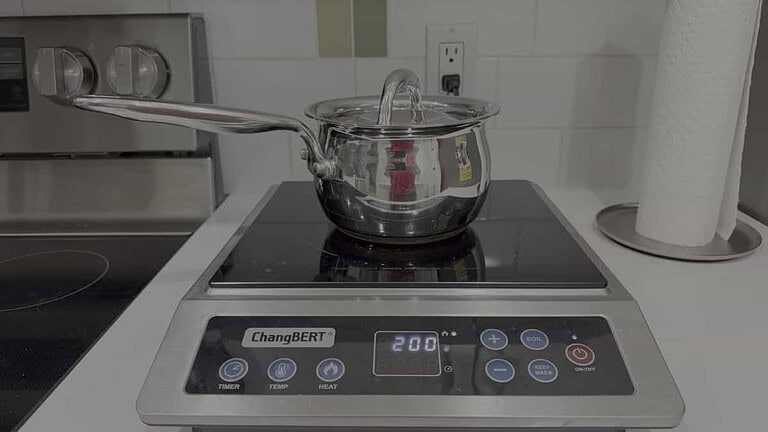
Duxtop’s popular 9600LS defaults to 5.0 and steps from 0.5 to 10. Level 0.5 is about 100 watts for keep warm. Here is the catch with many portables: at the low end, the unit does not truly run at low power. It cycles full power on and off, and the number is an average. Duxtop’s manuals for its newer models say levels 0.5 through 4.5 use this power cycling, while 5 and up run continuously, reaching 1,800 watts at 10.
That on-off pulsing is why some people say their portable “can’t simmer.” A heavier pan helps a lot, and so does temperature mode on models that have it. I explain the difference in power mode vs temperature mode.
How to simmer on induction without boiling over
- Bring it to a boil, then drop to 2 or 3. Do not try to creep up to a simmer from a low number. You will wait forever.
- Use a heavier pot. Thick, fully clad or enameled cast iron pots smooth out the pulsing. Thin pots bounce between boiling and nothing.
- Match the pot to the zone. A small saucepan on a big zone can overshoot; a big stockpot on a small zone simmers unevenly.
- Put the lid half on. Lids trap heat, and induction is efficient enough that a fully covered pot often boils even on 3.
How to sear on induction
Preheat the empty pan on 7 or 8 for a minute or two, add a high smoke point oil, and let it shimmer before the steak goes in. Cast iron and carbon steel hold heat best for searing; my notes on cast iron on induction cover how to avoid scratching the glass. Skip Boost for searing. It is designed for boiling water and can overheat an empty pan fast, which can warp thinner pans or damage nonstick coatings. If you want a real-world example, try my seared ribeye on induction.
What Boost really does
Boost (also called PowerBoost, SpeedBoost or Pb) borrows power from a neighboring zone for a short time, often around 10 minutes, then drops back to the top regular setting. It is great for boiling a big pot of water. It is not meant for all-day cooking, and you may notice the zone next to it is limited while Boost is on. That is normal, not a fault.
Things that change the right number
- Your pan. Thin, light pans run hotter at the same setting than heavy clad or cast iron. If you are shopping, my guide to the best induction cookware sets explains why fully clad pans are the easiest to control.
- How much food. A pot of soup needs more power than a cup of sauce.
- Zone size. Bigger zones have more power. A 7 on a small zone is gentler than a 7 on the big one.
- Your circuit. Portables plugged into a busy kitchen circuit may run below their rated 1,800 watts. My portable induction electrical guide explains why.
Induction settings FAQ
What number is medium heat on induction?
On a 1 to 9 scale, medium is about 5. On a 1 to 10 portable, about 5 to 6. If a recipe says “medium-high,” start at 6 or 7.
What setting is simmer on induction?
Usually 2 or 3. Bring the liquid to a boil first, then drop the setting and watch it for a minute.
Why does my induction cooktop click on and off at low settings?
Many induction units cycle power at low settings instead of running continuously. The clicking is the relay. It is normal, though if the whole unit shuts off, check my guide to an induction cooktop turning on and off.
Is temperature mode accurate?
It is a target, not a thermometer reading of your food. The sensor sits under the glass and reads the bottom of the pan, so the actual food temperature can differ. For frying oil, use a clip-on thermometer.
Canning is its own case, because you need to hold a full rolling boil for a long time without the cooktop cutting out. See canning on an induction cooktop.
The short version
Keep warm on 1, simmer on 2 to 3, eggs and sauces on 4 to 5, sauté on 5 to 6, fry and sear on 6 to 8, boil on 9 or Boost. Start one notch lower than you would on gas, start high and come down, and give yourself a week. After that, you will not want to go back.