True Induction TI-2C Dual Burner Cooktop Review
As an Amazon Associate, we may earn a small commission from qualifying purchases.
The True Induction TI-2C is an older dual-zone induction cooktop. Its appeal depends on the controls, supported cookware, electrical requirements and amount of cooking space available. Energy and time savings vary by use and model.
The True Induction TI-2C dual-burner cooktop combines two induction cooking zones in one unit. Check current manufacturer documentation for installation options and clearances rather than assuming that every revision is identical.
See Also: Portable Induction Cooktop Reviews
Below are the TI-2C’s key practical considerations, including two-zone power sharing, cookware compatibility and installation requirements.
True Induction TI-2C: Dual-Zone Features and Power Requirements
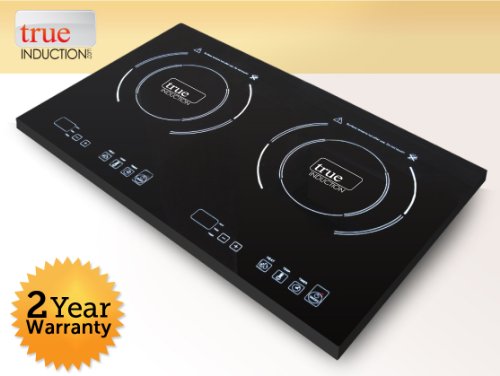
The True Induction TI-2C is designed as a portable dual-burner cooktop, offering more flexibility than a permanently installed unit. Before using it, check the manufacturer’s power requirements and the electrical rating of the outlet and circuit. Follow the supplied instructions and avoid assuming that any available outlet is suitable.
Before purchasing, compare the exact product revision with the official True Induction TI-2C specifications and the manufacturer’s 2019 TI-2C portable manual (PDF). The current product page lists 1,750 watts shared between two zones at 120 V/60 Hz, while the 2019 manual lists 1,800 watts. Check the rating label and instructions for the specific unit rather than mixing revisions. The TI-2B is a different, built-in model with its own installation requirements.
Features
The listed features can offer useful cooking flexibility, but they do not eliminate burn risks or guarantee greater efficiency than another appliance:
- Pan detection may interrupt heating when cookware is removed, but the pan and glass can remain dangerously hot. Check how the exact unit handles shutoff and residual heat.
- This portable model does not require permanent cooktop installation, but you should confirm that the outlet and circuit meet the manufacturer’s electrical requirements before use.
Practicality
Two burners can be convenient when preparing more than one part of a meal, but the total available electrical power and how it is shared between zones are important limitations to understand.
- A smooth glass-ceramic surface can simplify cleaning once cooled. Use only manufacturer-approved care products and methods.
- The size is manageable. You can leave it on the countertop but it fits in most kitchen cupboards too. If you plan on only using it occasionally it’s ideal if you can store it away when not in use
Technical information and dimensions
If you want to know the detail of what you’re purchasing, here is a list of the most important features:
- The manufacturer currently lists a height of 2.5 inches. Cabinet and ventilation clearances still must comply with the operating instructions; do not assume it can safely run under every cupboard.
- The manufacturer currently lists approximately 23 7/8 inches wide by 15 3/8 inches deep. Confirm the exact version’s dimensions and clearance requirements before buying or storing it.
- It weighs 11.2lb. Though it’s not light, most people will be able carry it over short distances
- The manufacturer currently specifies 1,750 watts with power sharing across both burners. Refer to your particular unit’s rating label, since older versions and listings may vary.
The True Induction TI-2C dual-burner cooktop is described as using power sharing when both zones operate. That may limit their simultaneous maximum output; it does not establish that this model always uses less energy for a given meal. Consult the exact unit’s manual.
Pros
- Easy cleaning thanks to ceramic cover
- Responsive heating of compatible cookware, though the pan and food still take time to warm and cool.
- Actual value depends on current price, warranty support and whether portable installation meets your needs.
- Double burner feature helps you prepare two dishes at once
- No open gas flame, but hot pans, glass and cooking oil can still cause burns and fires.
- Portable design intended for suitable cooking locations; confirm the manufacturer permits the planned setting and that electrical, weather and clearance requirements are met.
- Energy efficient
- Model-dependent cookware detection can stop active heating; this does not make unattended cooking safe.
- Displayed temperature settings do not guarantee the actual pan or food temperature, or eliminate residual heat in the glass.
Cons
- Like other glass-ceramic cooktops, its surface can crack if struck or subjected to unsuitable loads. Stop using a unit with damaged glass and consult authorized support.
- Long-term reliability is difficult to assess without independent testing. Confirm the current warranty and available manufacturer service.
- Preset temperatures do not guarantee measured food temperature. Compare the listed control steps and low-simmer performance with the types of cooking you plan to do.
- The two burners share a maximum electrical power budget; increasing output on one may reduce the available power on the other. This is normal power management, not necessarily a temperature-control fault.
- Pan-base dimensions and spacing limit which cookware can be used effectively. Verify the manufacturer’s supported pan sizes before using oversized cookware.
- You can’t use all your usual pots on this stove
- A range hood or other appropriate kitchen ventilation may still be needed. Cooking food and oil can produce particles and odors even without gas combustion.
Conclusion
The True Induction TI-2C may offer flexibility where its dimensions, power supply and installation rules are suitable. For a single-zone alternative, compare the True Induction TI-1B review; verify the actual wattage and revision before buying.
What’s so exceptional about induction cooking?
Induction offers responsive control and efficient energy transfer with compatible cookware, but its overall benefits depend on the appliances being compared. Our induction-versus-gas comparison explains the trade-offs, including ventilation and energy costs.
- Induction cooking saves energy because of the unique way heat is generated. Heat is transferred directly to the cookware and less energy is lost
- Induction has no exposed gas flame and generates heat inside compatible cookware, but hot pans and residual glass heat can still burn skin. Continue supervising cooking and follow the appliance’s hot-surface warnings.
- Since heat is generated in the presence of cookware, you don’t have to wait for an induction burner to heat up; your cooking can start directly
What pots can you use?
Induction requires cookware with a suitable magnetic base. Cast iron and some stainless-steel pans work, but ordinary glass, aluminum and copper pans may need a specially designed induction-compatible base.
A magnet sticking firmly to the flat bottom of a pan is a useful first test, but cookware also needs a supported base diameter and an induction-compatible construction. Check the cookware label and cooktop’s instructions before use.
You do not necessarily need cookware from the cooktop manufacturer. Look for pans identified as induction-compatible, with flat magnetic bases in the size range supported by the appliance.
Practical uses of induction cooking
The benefits of induction cooktops make them practical for use outside the home kitchen. Think about placing one in these scenarios:
- A portable induction cooktop may be useful at an electrical campsite when appliances are permitted and the available outlet and circuit meet its specifications. Always follow the appliance’s safety instructions.
- Portable cooktops come in different sizes. A single-burner model takes up less space, but should only be used where cooking appliances are permitted and there is a suitable electrical outlet.
- Portable cooktops can provide an extra cooking zone in a properly equipped kitchen or other permitted cooking area. Keep the appliance on a stable, heat-resistant surface, away from walkways and anything combustible; see our induction safety guide.